
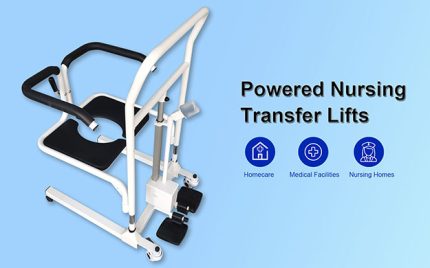





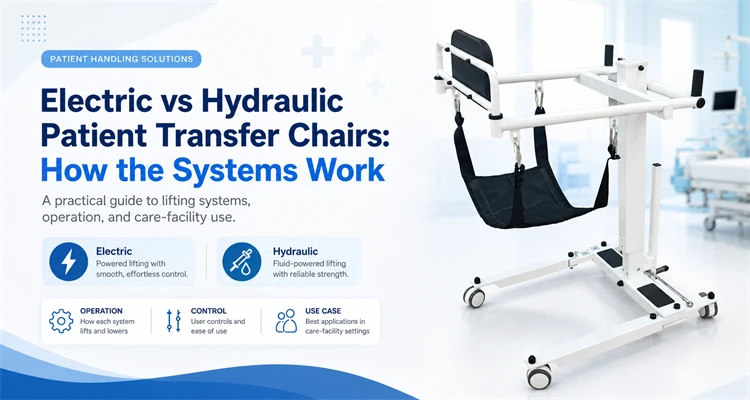
Electric and hydraulic patient transfer chairs share the common function of altering height so a person in a seated position may be transferred from one surface to another with less strain on the user. The primary differentiating factor is the mechanism used to generate and control the lifting force.
An electric chair uses a battery powered actuator which is either foot controlled or a handset. A hydraulic chair uses a pump cylinder which is raised via multiple foot strokes and lowered via a release control. The manner in which it lifts the patients dictates the flow, the effort, the charging, the maintenance, the noise, and the be prepared for the next transfer.
1. First Confirm That A Transfer Chair Fits The Task
Most transfer chairs are designed for seated transfer. The majority of models contain either a split or opening frame which can be maneuvered around the user, closed and locked, and then slightly elevated and then transferred to the receiving surface.
This is in contrast to a full body mobile lift with a sling. A transfer chair usually requires the subject to be supported in a sitting position. This may require trunk control, cooperation, or assistance as stated in the instructions. Other solutions are often required for long distance transfers.
2. How An Electric Transfer Chair Lifts And Lowers
An electric transfer chair has a couple of parts. It has a battery, a control box, either a handset or a control panel, and one or more linear actuators. When the control is triggered to move the chair up or down, power is sent to the actuators. The actuators then either retract or extend.
It is handy for the operator to be able to control the chair while keeping their hands near the handles. Plus, the electric chair does not need a lot of effort to control. It is great for those that need to make many transfers and for those that have limited energy to expend.
When comparing electric patient transfer chairs, check more than battery voltage. The control position, lifting speed, charge indicator, emergency stop, emergency lowering method, actuator protection, and access to replacement batteries all affect daily use.
3. How A Hydraulic Transfer Chair Lifts And Lowers
Hydraulic transfer seats use a foot operated pump to create lifting force. When the hydraulic pump is repeatedly operated, the lifting fluid is moved to a sealed chamber to raise the chair. Lowering is done by releasing a control that allows the lifting mechanism to move downward.
Because there is no battery, the chair can be used in a room that does not have a convenient charging station. Of course, there are some things that the operator has to trade for this energy independence. The operator has to learn how the release control affects how fast the chair lowers.
There are lots of hydraulic transfer chairs on the market. How the control works, the foot pedal position, and how the release affects the control all need to be evaluated in person. These things directly affect how the hydraulic chair can be controlled and lowered in a small space.
4. Electric And Hydraulic Systems Compared
| Decision Point | Electric System | Hydraulic System |
|---|---|---|
| Lifting force | Battery-powered actuator | Manual hydraulic pump |
| Primary control | Handset or control buttons | Foot pedal with release control |
| Operator effort | Low lifting effort | Repeated pedal action required |
| Readiness requirement | Sufficient battery charge | Functional pump and fluid seals |
| Lowering behavior | Powered down control, often with emergency backup | Controlled hydraulic release |
| Routine attention | Charging, battery condition, cables, actuator | Leaks, seals, pedal, valve, cylinder |
| Operating sound | Actuator motor sound | Usually quiet pump strokes |
| Workflow fit | Frequent transfers and repeatable powered movement | Lower transfer frequency or locations without charging |
5. Charging And Power Planning For Electric Chairs
An electric chair needs a simple but dependable charging process. Leaving charging to individual memory can result in a chair that is available physically but not ready to lift.
Battery life changes with age, load, temperature, and charging habits. Procurement planning should therefore include replacement availability, battery identification, storage instructions, and the expected service interval rather than relying only on the new-battery runtime.

6. Hydraulic Maintenance And Readiness
Hydraulic systems remove charging from the workflow, but they are not maintenance-free. Pump performance depends on the cylinder, seals, fluid circuit, pedal linkage, and lowering valve remaining in good condition.
7. Space And Furniture Fit Can Change The Best Choice
The lifting mechanism is only one part of chair fit. In a compact bedroom or bathroom, the external width, turning radius, caster diameter, pedal projection, handset cable, and space needed behind the operator may determine whether the transfer can be completed cleanly.
Hydraulic pumping needs foot access beside or behind the chair. Electric controls reduce that pumping movement, but the actuator, control box, or battery may add bulk. Both types need enough under-bed or under-chair clearance for their legs and a route without obstacles that can catch small casters.
8. Matching The System To Different Care Scenarios
| Care Scenario | System Characteristics That Help | Points To Confirm |
|---|---|---|
| Frequent bed-to-chair transfers | Powered, repeatable height changes | Battery routine, actuator speed, bed clearance |
| Occasional transfer in one room | Simple hydraulic operation may be practical | Pedal access, operator effort, lowering control |
| Shared equipment across several rooms | Electric with spare battery or hydraulic without charging dependence | Availability, storage, cleaning, staff familiarity |
| Toileting | Seat opening, close approach, controlled height matching | Toilet clearance, hygiene access, locks, removable parts |
| Showering | Wet-area-approved materials and components | Water resistance, corrosion, drainage, cleaning method |
| Small rooms | Compact frame and low-effort positioning | Turning radius, pedal or actuator projection, caster control |
| High daily transfer volume | Reduced repetitive operating effort | Charging capacity, backup plan, service response |
A shower setting should never be assumed from the chair’s appearance. Electrical protection, corrosion-resistant components, upholstery, drainage, and cleaning instructions must all support wet-area use. A chair described only for dry transfer should remain in dry environments.
Conclusion
Electric transfer chairs rely on a rechargeable power system and actuator to lift with the help of buttons. Hydraulic transfer chairs rely on the caregiver to operate a foot pump and release valve to adjust the chair to the desired height. The electric chair will be more advantageous in a high transfer situation and in situations where the operator has limited effort but will have to charge between uses. The hydraulic chair will be more advantageous in situations with limited space and maintenance capability.
The transfer method of the person and the physical route must be understood and compared against the range of lift, controls, locks, casters, emergency operation, cleaning, and service support. The chair has to be capable of covering the entire transfer process, not just height adjustment.
FAQ
The Main Difference Between Electric And Hydraulic Transfer Chairs
Electric transfer chairs use battery and actuator technology and buttons. Hydraulic transfer chairs use a pump and release valve.
Whether A Hydraulic Chair Is Easier To Maintain
While a battery and charging system is eliminated, a pump and seals, along with a release valve, will require periodic maintenance.
What Happens If An Electric Chair Loses Power
The response depends on the model. Suitable systems provide a defined emergency lowering method, and this function should be tested during setup and training.