
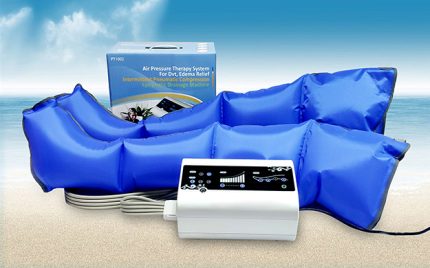





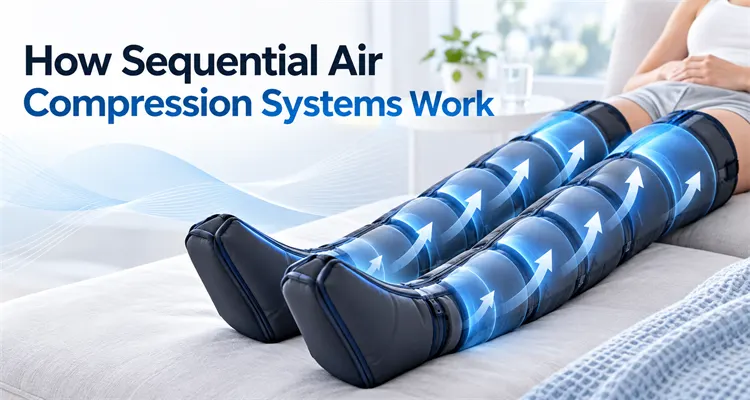
The sequential air compression system is made up of two main components: a pump and a multi-chambered garment. Both components are used to produce a controlled wave of pressure. Unlike other systems that fill each chamber simultaneously, sequential air compression systems open up the air paths in a pre-determined order (usually starting from the distal end of the limb and moving proximally). The pressure level, chamber timing, hold time and release time will ultimately dictate what the wave feels like and how long it takes for each cycle to complete.
The order of the specifications will make comparing specification sheets much simpler. A single chamber does not mean that you are getting performance. There needs to be sufficient air flow from the pump; the valves must control where the air goes; the controller must maintain the appropriate pressure; and the garment must fit properly to allow the inflation to be converted into continuous compression.
Les cinq étapes qui composent un cycle de compression séquentiel
The entire system is connected to each other through the use of pneumatic circuits. Changes in any single portion of the circuit will affect either the timing or pressure of the complete cycle.
Pompe et débit d'air
The pump pulls in air and then pushes it through a tube to the garment. Pressure refers to the maximum level of force that is achieved within an active chamber. Air flow refers to the rate at which the system is able to fill up the available chamber space. Just because you have a higher pressure setting doesn’t necessarily mean you’ll be able to inflate the garment any faster; conversely, having a high air flow doesn’t necessarily mean you’ll be able to control the pressure accurately.
Vannes et conduits d'air
Internal valves control the flow of air. The controller is able to fill up an individual chamber with air, keep the other chamber filled with air, or let go of air from some part of the garment because of the internal valves. There are some systems where there are separate lines for each chamber. Other systems use a manifold or connector that allows multiple channels to be routed into a single organized interface.
Vêtement à plusieurs compartiments
A single air chamber is formed by a sleeve, boot, cuff, or wrap; each has varying numbers of air chambers (the number of chambers, their length, the degree of overlap, and how they are oriented) to determine what type of pressure wave is produced. When the air chambers overlap, it helps eliminate gaps in the pressure wave. However, when the air chambers do not overlap, there are fewer segments in the pressure wave. Additionally, the size of the garment and the amount of tension used when closing it will affect the total volume that the pump must fill with air.
Capteur de pression et régulateur
Pressure sensors provide feedback to the controller regarding the active pneumatic circuit. This information is then compared to the desired level by the controller and the pump and/or valves are adjusted accordingly. Depending on how the system was designed, pressure can be controlled across the entire garment, within each chamber, or using a programmed sequence.
Programme de chronométrage
The timing program will establish the start time for the filling of each chamber, the duration of maintaining pressure, the time at which each chamber is released and the duration of the pause prior to starting the next cycle. This timing logic allows for an ordinary inflation process to become a repeatable sequence.
Que se passe-t-il au cours d'un cycle complet ?
- L'utilisateur enfile le vêtement et sélectionne la pression, le mode et la durée de la séance proposés par l'appareil.
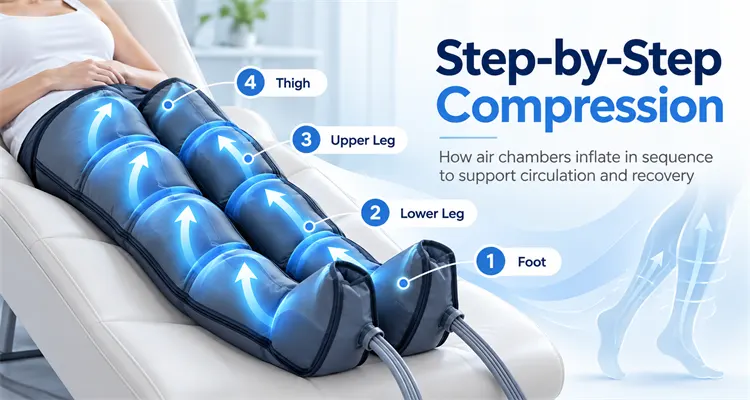
- La pompe commence à remplir la première chambre, généralement celle qui est la plus éloignée du torse.
- Lorsque le système de commande atteint la condition de pression ou de temps définie, le flux d'air passe à la chambre suivante.
- Des compartiments supplémentaires se remplissent les uns après les autres, créant ainsi une onde de pression le long du vêtement.
- Les chambres déjà remplies peuvent rester sous pression, se dépressuriser partiellement ou voir leur pression varier en fonction du mode sélectionné.
- À la fin de la phase active, les vannes libèrent l'air et le système entre dans une phase de pause ou de transition avant de recommencer le cycle.
Le schéma précis varie. Dans un programme, la chambre n° 1 peut rester gonflée pendant que les chambres n° 2 et n° 3 se remplissent. Dans un autre, la première chambre peut commencer à se dégonfler dès que la chambre suivante s'active. C'est pourquoi deux appareils dotés du même nombre de chambres peuvent produire des schémas de compression différents.
Interaction entre le contrôle de la pression et la durée du cycle
Pressure and Time: These two elements are related to one another; however, they are each unique as far as their respective setting is concerned. Your chosen Pressure sets a goal, while the Device will require sufficient Time and Airflow to achieve this Goal in all parts of the Garment.
Réglage de la pression
Pressure as displayed is usually a control target or program value. It is not an accurate representation of pressure at all points on the body. Many variables such as garment fit, limb shape, posture, overlap of chambers, resistance in tubes, and motion will alter the pressure experienced throughout the contact area.
L'heure de l'inflation
The inflation process takes different amounts of time depending upon how much air is pumped out and the size of the space being filled. More air is needed for larger garments, looser fitting garments, longer tubes, or when several chambers are being pressurized at once. When a controller advances based primarily on time, there is a greater chance that the final pressure will differ from garment volume. However, when the controller advances based upon pressure feedback, the amount of time that each step lasts can vary as the system tries to achieve its target pressure.
Maintenir, relâcher et mettre en pause
In some instances, after a chamber has filled with air, the program will continue to hold the pressure in the chamber for a short amount of time. Once the pressure is held for a certain amount of time, the program will deflate the chamber by releasing enough air so that the pressure drops back down, which may be followed by a predetermined resting period. Therefore, the total cycle time for a single chamber does not just include the time it took to fill the chamber with air, but also other steps such as sequential filling of the chamber, holding the pressure in the chamber, deflating the chamber, and transition time.
Conseil pratique :
To understand what is included in the manufacturer’s definition of “cycle time” when comparing different equipment models, ask if it encompasses the entire garment sequence and release phase, or just one inflation step.
Comparaison entre la compression séquentielle et le gonflage simultané
Ces deux modèles utilisent la pression d'air, mais ils l'organisent différemment. Ce qui importe, ce n'est pas de savoir quel nom semble le plus sophistiqué, mais si le schéma de pression correspond au programme de fonctionnement prévu.
| Point de comparaison | Compression séquentielle | Inflation simultanée |
|---|---|---|
| Action de la chambre | Les chambres s'activent dans un ordre prédéfini | Toutes les chambres reliées entre elles se remplissent simultanément |
| Profil de pression | Une onde de pression en mouvement ou provoquée | Une pression généralisée exercée à peu près au même moment |
| Commande de vanne | Nécessite un acheminement chronométré entre les chambres | Utilise une logique de gonflage partagée plus simple |
| Cycle behavior | Includes multiple chamber steps and release logic | Centres on whole-garment inflation and deflation |
| User sensation | Often feels progressive along the garment | Often feels more uniform across covered areas |
| Key specification | Sequence order, overlap, chamber timing, pressure control | Overall pressure, inflation uniformity, hold and release time |
Simultaneous inflation can be suitable when the desired function is broad, uniform compression. Sequential operation is selected when a staged wave is central to the program. Some systems offer several modes and may combine sequential, alternating, or simultaneous behavior; mode names should be checked against the actual chamber diagram and manual.
Why Chamber Count Does Not Tell the Whole Story
The addition of more chambers will provide for additional options of potential pressure zones, however; more chambers require more volume, valve control, tubing and timing. A four-chamber system that is coordinated well may appear more consistent than a system with a larger number of chambers that does not have good garment fit or slow response of the controls.
- Chamber overlap determines whether pressure zones blend or leave distinct boundaries.
- Garment length and circumference determine the total air volume.
- Valve response affects the transition between chambers.
- Pump airflow affects how quickly each chamber approaches its target.
- Pressure feedback affects consistency as garment volume changes.
- Deflation design affects how fully and quickly the garment releases between cycles.
What the User May Observe During Operation
A natural flow of air can be seen in the motion of the garment and its control panel. When the first chamber inflates, the next one will follow suit. This process will continue as long as it is set to do so by programming. The garment should remain attached to the user during the entire treatment period, and the closures should remain intact.
Slow filling, repeatedly failing to reach the chosen set point, unevenness within the chamber, unintended drop in pressure, or stopping during a cycle can all be indications of a loose connection, bent tubing, open zipper, leaking garment, restricted airflow, improper fit, or hardware malfunction. Inspections must be performed according to the user’s manual and not by replacing internal components.
How to Compare Sequential Compression Systems
A good comparison is made when you look at the control unit and all garments that will be used with it. If you test only the pump and do not include the largest garment, you may miss issues related to slow filling or compatibility.
- Confirm the number of independently controlled air channels and the actual chamber sequence.
- Compare selectable pressure range and adjustment steps by exact model.
- Ask whether cycle timing is fixed, pressure-responsive, or selectable.
- Check whether earlier chambers hold, release, or reduce pressure as later chambers fill.
- Test the smallest and largest compatible garments for filling time and connection stability.
- Review noise, heat, tubing layout, connector design, cleaning instructions, and replacement garment supply.
For product-level evaluation, compare the control logic and compatible garments together. A page for sequential air compression systems should show the chamber pattern, pressure range, available garments, cycle information, controls, and included accessories for the exact configuration.
Care and Maintenance Factors That Affect the Sequence
Dust at the air inlet, worn tubing, loose connectors, folded garments, and damaged chambers can change airflow or pressure response. Routine care should include checking the filter where replaceable, inspecting tubing and connectors, laying the garment flat before use, cleaning it by the stated method, and storing it without tight folds.
Replacement garments and tubing should match the channel arrangement and connector design of the control unit. Physical connection alone does not prove that chamber order, pressure behavior, or timing is compatible.
Questions fréquemment posées
Does Sequential Compression Mean Every Chamber Reaches the Same Pressure
Not necessarily. Some systems apply one target across the garment, while others use chamber-specific control or preset gradients. The operating manual and chamber program provide the clearest answer for a particular device.
Is Cycle Time the Same as Session Time
No. Cycle Time is the amount of time a single inflate/deflate cycle takes. Session Time is how long the machine will repeat that same cycle until either it shuts down or you change the settings.
Can a Sequential System Also Inflate All Chambers Together
Many multi-mode systems are capable of doing so, however, it depends on the specific system. Please refer to the mode diagram for verification of whether each multi-chamber system will simultaneously inflate.
Why Does a Larger Garment Take Longer to Fill
A larger garment will typically contain more air. As a result of this, it can take longer for the pump and controller to attain the desired pressure. This is particularly true if multiple chambers are still inflated at the time the sequence begins.
What Is the Most Important Specification to Compare
No single value explains the whole system. Compare pressure range, airflow behavior, chamber layout, sequence logic, full-cycle timing, garment fit, controls, and compatibility as one operating package.
Conclusion
Sequential air compression relies upon coordination. The pump provides airflow; valves direct the airflow; chambers create the pressure wave; sensors provide information for pressure control; and, timing dictates when each stage will begin and end. Inflation in unison also utilizes the same fundamental pneumatic components, however, the chambers are filled simultaneously rather than as a step-by-step process.
The clearest way to understand or compare a system is to follow one complete cycle and ask what each chamber is doing at every stage. That reveals more than chamber count or maximum pressure alone.