




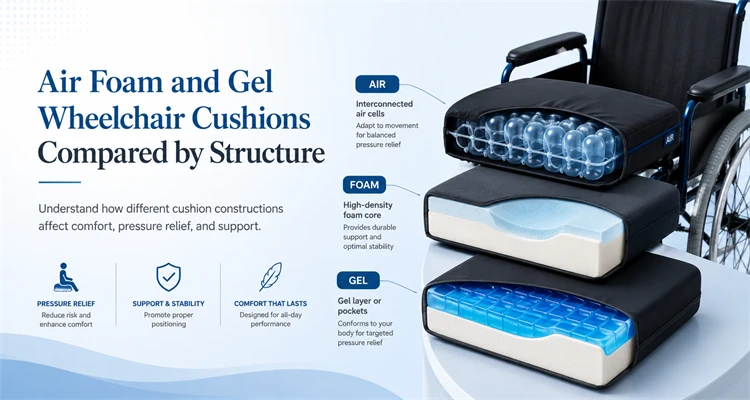
Air, foam, and gel cushions have varying designs for airflow, stability, and flexibility. Air cushions contain different sized or connected inflatable chambers, foam compresses, and gel or fluid moves within a layer. Different designs have implications for price, heat retention, stability, weight distribution, and the reliability of daily use.
There is no best material for cushions. The criteria that determine the best cushion is the weight, height, body dimensions, posture, time of day the cushion is used, and the user’s ability to care for the cushion. Many sophisticated cushions also incorporate multiple materials, having a base of shaped foam with an insert of gel or air.
1. Why Cushion Structure Changes Performance
A wheelchair cushion has a direct impact on the body as well as the pelvis and balance. It can affect the user’s ability to propel the chair, transfer, reach, and even contact pressure. Two cushions made of the same general material can have very different characteristics depending on the depth of the contour, the height of the chamber, the density of foam, the design of the chambers, the placement of the insert, and the tension of the cover.
The seating system as a whole should be evaluated, including the cushion, cover, the wheelchair seat, the back support, the armrests, and the user’s posture. A cushion can affect the user’s ability to access the wheels and controls, and can have an impact on how the user interacts with transfers surfaces.
2. How Air Wheelchair Cushions Are Constructed
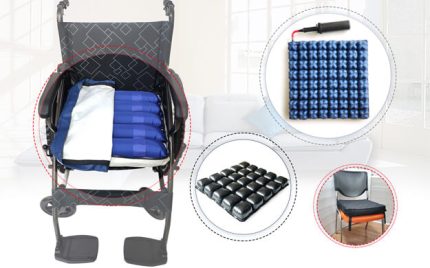
Sealed flexible cells are used in air cushions. As users sit, the cells deform and allow air to move either in a connected chamber or in separate zones, allowing the user to immerse in the air cushion. Some designs utilize one valve, while others allow sections to be adjustable or isolated for stability and positioning.
The design of a cushion’s cells, air volume, flexibility of the cushion material, layout of the air chambers, as well as the inflation state, affect the sitting posture. Too much air leads to a stiff, less immersive surface. Too little air allows the user to almost sit on the base of the cushion. Getting the right amount of air is part of the fitting process and should not be considered a preference for comfort.
When reviewing cuscini d'aria per sedie a rotelle, check valve access, air retention, cell bonding, repair support, cushion orientation, cover stretch, and the clarity of inflation instructions.
Typical Air Cushion Characteristics
- Adjustable immersion and pressure distribution.
- Low core weight in many designs.
- A responsive surface that may feel less stable to some users.
- Routine inflation and leak checks.
- Performance affected by punctures, valve condition, and air pressure changes.
3. How Foam Wheelchair Cushions Are Constructed
An air cushion positional aid is a foam cushion. Foam may be molded or cut. The types of foam used may be open cell, closed cell, or memory. Foam may have support features, be able to compress and recover, or be a combination of multiple types. Density tells us how much material of a given type is in a cushion. Stated simply, how much foam is in the cushion. Firmness, tells how much a cushion compresses under body weight.
A cushion constructed of flat foam provides basic cushioning. A contoured base includes a pelvic well, thigh channels, side supports, and/or zones across the base with a firm padding. Layered designs include a firm and stable base topped with a layer of soft padding.
Typical Foam Cushion Characteristics
- Predictable shape and a relatively stable sitting platform.
- No inflation adjustment or fluid redistribution routine.
- Often lighter than gel or fluid combinations.
- Compression, softening, or permanent deformation over time.
- Heat and moisture experience influenced by foam type, channels, and cover.
4. How Gel And Fluid Cushions Are Constructed
Gel cushions place a pad of gel or other viscous fluid between or on top of a foam base. Loading of such a cushion causes the gel or fluid insert to engage the rest of the body, while the foam base offers the contoured lateral stability and the supportive immersion of the pelvic region.
The term gel covers different materials and constructions. Insert thickness, compartment design, flow characteristics, foam contour, and resistance to leakage all affect performance. Some products require the insert to be redistributed or kneaded after storage or use, while others are designed for minimal adjustment.
Typical Gel Cushion Characteristics
- Conforming support through movement of gel or fluid.
- Stable positioning when paired with a contoured foam base.
- More weight than a basic foam cushion in many configurations.
- Inspection for leakage, hardened areas, or displaced material.
- A cool initial touch that may change as the cushion reaches body temperature.
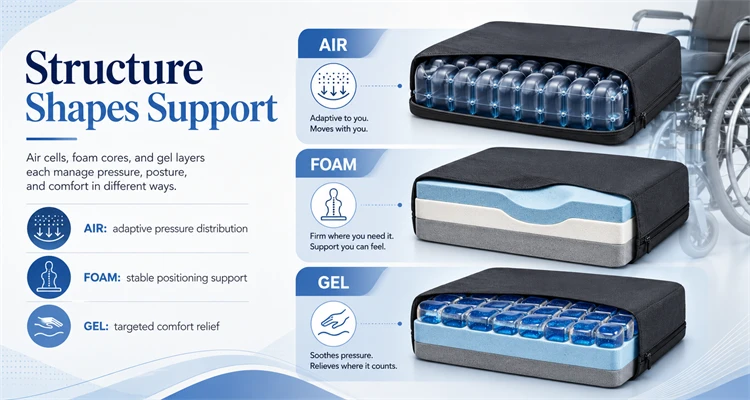
5. Air, Foam, And Gel Compared Across Daily Use
| Area di confronto | Aria | Schiuma | Gel Or Fluid |
|---|---|---|---|
| Load response | Cells deform and share air | Material compresses and recovers | Insert material displaces around the body |
| Distribuzione della pressione | Adjustable immersion when correctly inflated | Depends on contour, density, firmness, and depth | Conforms at the insert area, often over a foam base |
| Stabilità | Varies by cell height and chamber control | Usually predictable, especially when contoured | Often supported by the underlying foam contour |
| Peso | Often light | Usually light to moderate | Often heavier because of the insert |
| Adjustment | Inflation or zone adjustment | Normally fixed after selection | Usually fixed, with redistribution on some designs |
| Manutenzione | Air, valve, leak, and cover checks | Inspect compression, damage, and moisture | Inspect insert position, leakage, and foam base |
| Temperature feel | Affected by cover, cells, and airflow | Affected by foam type and ventilation channels | May feel cool initially but can retain warmth |
| Common fit issue | Overinflation or underinflation | Wrong contour or worn foam | Material migration, weight, or insert damage |
6. Pressure Distribution Is More Than Material Type
Pressure distribution is dependent on how much of the body is in contact with the cushion and whether or not the cushion allows for concentration of pressure. Air cushions will allow for deep pressure distribution, gel will allow for pressure to be concentrated around areas where there is greater pressure, and foam will allow for a greater distribution of pressure as well as control support.
A poorly fitted cushion from any category can perform badly. Width and depth must match the wheelchair and user; the pelvis should sit in the intended loading area; footrests should support the legs; and the cover should not become so tight that it limits immersion.
- Check support under the pelvis and thighs, not only surface softness.
- Observe whether posture shifts after several minutes of sitting.
- Confirm the user can perform the required weight shifts or repositioning.
- Reassess fit after weight, posture, mobility, or wheelchair changes.
7. Stability And Transfer Performance
Stability is important for reaching, propelling, and transfers. A high air-cell cushion may allow movement unless stability features are incorporated. Contoured foam will give a stable surface. A combination of a base with a foam insert may provide a surface that conforms as well as a stable surface.
Transfer stability is affected by the height of the cushion. A taller cushion will put the user in a more upright position and may require the user to change the way they reach or maneuver. Check the geometry of the wheelchair with the footplates and armrests and see if the center mass is in a stable position after transfers have been performed with the cushion.
8. Weight, Portability, And Maintenance
Cushion weight can affect how easily you can fold it for transport and how difficult it is to load it into your car. Foam and air cushions tend to be light, but gel inserts can increase weight, especially in larger or thicker cushions.
Maintenance depends on how frequently you use your cushion, but inflating air cushions and confirming they are not leaking is good practice. Gel cushions should also be checked for material issues. Foam cushions should be examined for damage and alterations to their shape. But regardless of your cushion’s material, they all rely on a cover that is the correct size and front to back orientation.
9. Temperature And Moisture Experience
Temperature cannot be predicted from the core material alone. Cover breathability, spacer fabric, ventilation channels, cell gaps, clothing, room temperature, sitting time, and moisture all influence the experience.
Gel may feel cool when first used because the material absorbs heat, but that sensation can reduce as temperatures equalise. Foam may retain warmth unless the structure and cover promote ventilation. Air-cell gaps can support some air movement, although an impermeable cover or compressed surface can change that effect.
10. Matching Cushion Structure To User Priorities
| User Priority | Structure Worth Considering | Selection Check |
|---|---|---|
| Simple, stable daily support | Contoured foam | Density, contour, recovery, and cover |
| Adjustable immersion | Air-cell cushion | Inflation skill, stability, valve, and leak plan |
| Conformity with a stable base | Gel or fluid insert over foam | Insert location, weight, leakage, and contour |
| Frequent independent transfers | Low-profile stable foam, hybrid, or zoned air | Height, edge stability, wheelchair setup |
| Limited ability to maintain equipment | Low-maintenance foam or fixed hybrid | Inspection support and replacement interval |
| Long sitting duration | Individually fitted air, shaped foam, or hybrid | Pressure distribution, posture, heat, and review |
| Frequent transport | Light foam or air design | Carry weight, folding, setup after travel |
A broader wheelchair pressure relief cushion range should include different structures because users do not share the same balance of pressure care, stability, maintenance, weight, and budget priorities.
11. What To Test Before Final Selection
- Correct width, depth, orientation, and attachment to the wheelchair.
- Pelvic position, thigh support, foot placement, and back support.
- Sitting response after initial loading and after a longer trial.
- Forward, lateral, and transfer stability.
- Ease of inflation, inspection, cleaning, and cover replacement.
- Cushion weight during wheelchair transport and daily handling.
- Availability of repair parts, replacement covers, and fitting instructions.
Conclusione
Body support is provided by air, foam or gel wheelchair cushions as air moves, material is compressed or gel is displaced. While air is adjustable, foam is structurally predictable and gel adds conformity to a stable foam base. Hybrid designs combine these properties.
Posture, pressure distribution, sitting time and transfer methods, the ability to maintain the cushion, temperature comfort, and wheelchair fit should be considered. The cushion that is the best fit for the user is the one that fits the structure and can be maintained on the user daily.
FAQ
Whether Air Cushions Always Provide More Pressure Relief
Air can provide high immersion, but performance depends on inflation, cell design, fit, and maintenance. A correctly shaped foam or hybrid cushion may be more suitable when stability or low maintenance is the priority.
Whether Gel Cushions Stay Cool All Day
Gel can feel cool initially, but temperature changes with sitting time, cover, clothing, ventilation, and room conditions. The full cushion construction matters more than the first-touch sensation.
How Often An Air Cushion Needs Checking
Check air cushions when support changes. While cushions must be checked, regular checks also include looking for irregular cells, cover condition, and the contact base of the cushion.
When A Foam Cushion Should Be Replaced
Replacement should be considered when foam no longer recovers, remains compressed, cracks, changes shape, becomes contaminated, or no longer supports the intended posture.
Whether Hybrid Cushions Are Better Than Single-Material Cushions
Hybrid designs combine stability and conformity, but they also have fitting and maintenance issues from their components. The suitability is based on the user’s priorities and set up.