







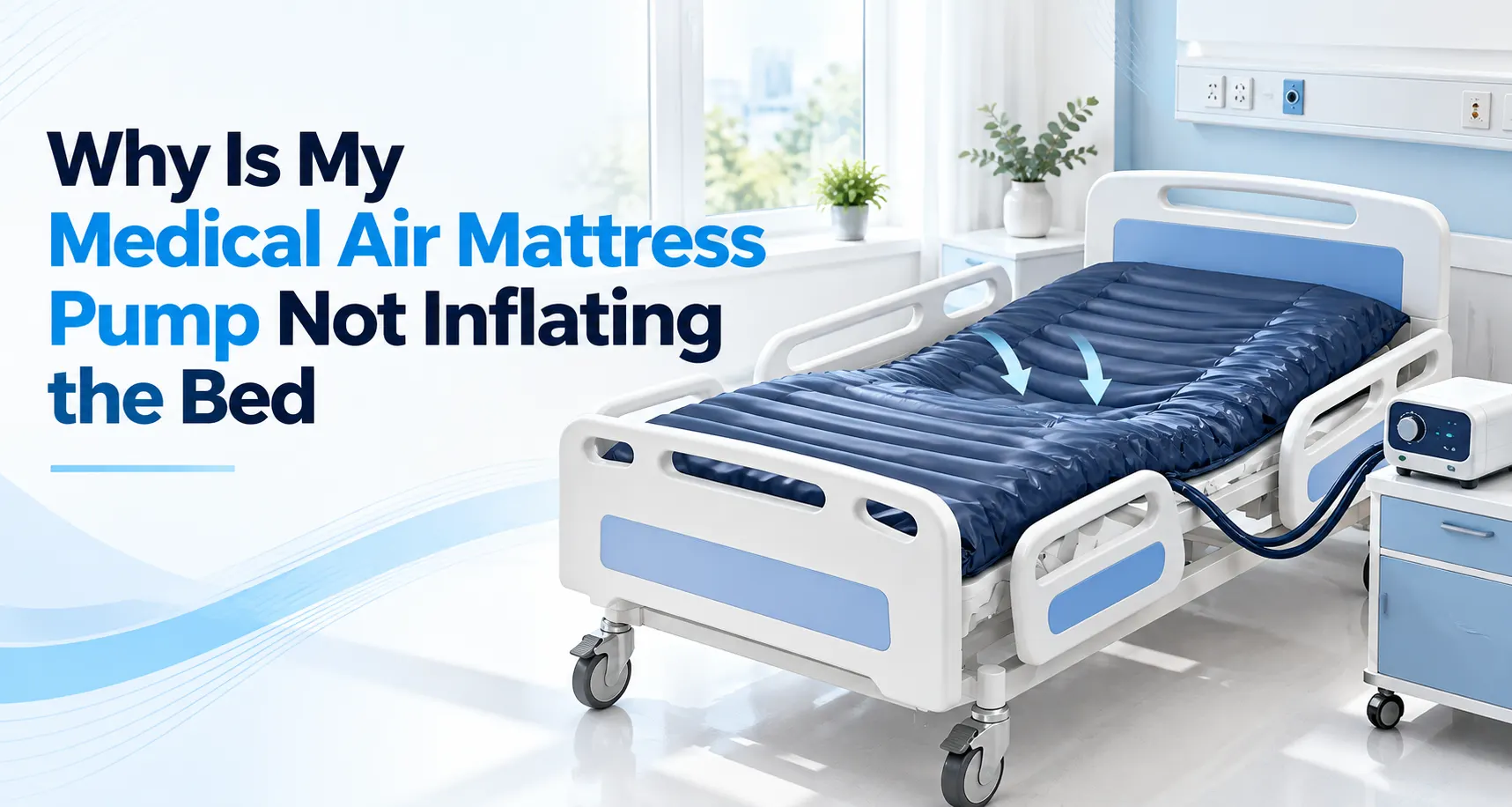
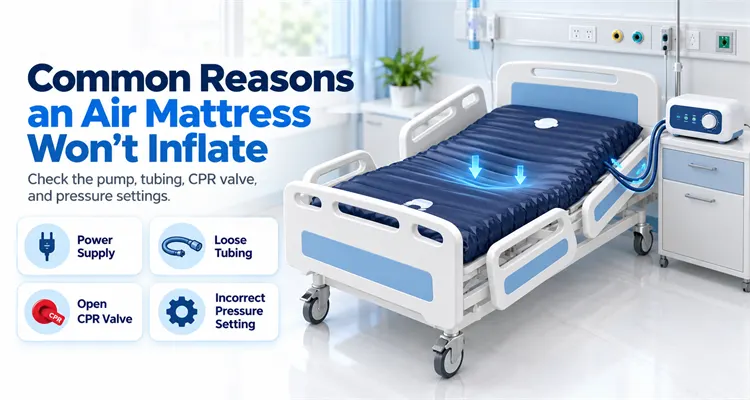
If a medical air mattress pump is running but the mattress does not inflate, the most common reasons include a blockage in the tubing; an incomplete connection; an open CPR valve; a leak in the air system; a clogged intake filter; or inadequate pump performance. Begin with the mattress and hose route and then proceed to fix each issue individually. Leave the interior inspection of the pump to the designated service center.
Before attempting to resolve a problem, ensure that the user has a proper surface to lie on and support to assist with the transfer or movement of the user from one position to another as specified in the care plan. If possible, try to inspect the user’s empty mattress before beginning the startup process for the specific mattress and pump used, since each product will have different inflation times, CPR control options, connector locations, alarm functions, and testing procedures.
Identifica el patrón de inflación antes de cambiar nada
La expresión «no se infla» puede referirse a varios fallos distintos. Observar el patrón permite acotar la búsqueda y evita ajustes innecesarios.
| Lo que observas | El lugar más probable donde buscar | Primera acción |
|---|---|---|
| Todo el colchón se mantiene plano | Manguera principal, conector, válvula de RCP, salida de la bomba | Comprueba todo el recorrido del aire desde la bomba hasta el colchón. |
| El colchón se infla muy lentamente | Tubo retorcido, válvula CPR parcialmente abierta, filtro sucio, pequeña fuga | Compáralo con el tiempo de inflado inicial del modelo |
| Una celda o una zona se mantiene sin cambios | Manguera de la célula, conexión del colector, célula dañada | Inspecciona la sección afectada y su conexión |
| El colchón se infla y luego se ablanda | Fuga, conector suelto, junta CPR, cambio de modo | Presta atención y comprueba si hay pérdida de presión tras el inflado |
| Las celdas se ablandan y se vuelven a llenar de forma alterna | Es posible que el ciclo de alternancia normal esté activo | Observa un ciclo completo antes de diagnosticar una avería |
| La bomba funciona con una alarma de baja presión | El sistema no puede alcanzar ni mantener la presión deseada | Lee el indicador y, a continuación, sigue los pasos que se indican a continuación en el orden indicado. |
No se debe dar por sentado que todas las celdas blandas estén defectuosas. En el modo alterno, un grupo de celdas puede reducir la presión mientras que otro grupo sostiene la superficie. Es más probable que se trate de un fallo cuando los grupos esperados no se rellenan, el colchón nunca alcanza su estado de funcionamiento o la indicación de baja presión persiste más allá del periodo normal de arranque del modelo.
Sigue la ruta aérea en siete pasos
Paso 1: Confirma el arranque, el modo y el tiempo de inflado
Confirm the pump is linked with the compatible mattress, turned on and is functioning in the selected operation mode. Many systems include controls for transport, standby, mute, seat-inflate, static or maximum-inflate which alter the function of the pump. A motor noise by itself cannot confirm that air is being delivered to the appropriate outlet.
- Comprueba los números de modelo de la bomba y del colchón, así como la compatibilidad de los conectores.
- Comprueba que no haya ninguna función de pausa, espera o transporte activa.
- Fíjate en los indicadores de presión, modo y alarma, en lugar de guiarte por el sonido.
- Deja que transcurra todo el periodo de inflado inicial indicado para el modelo.
- Si el sistema dispone de un indicador de «listo», espera a que se active ese estado antes de evaluar el soporte.
The time required to inflate a large replacement mattress is typically longer than that of a small mattress overlay. Additionally, bed movement (articulation) and additional weight can affect the rate at which the mattress system becomes operational. Therefore, the first step in diagnosing potential problems with the mattress system should be done with the bed in a flat position and without any additional weight, provided that the product manual permits such testing.
Paso 2: Sigue el recorrido de los tubos de aire desde la bomba hasta el colchón
Check each tube using your hands and eyes to verify it is clear of obstructions from the point of connection to the pump to the point where the tube enters the mattress. Be sure to check around the headboard, on the side of the bed frame, under the fixing straps, and around any articulating areas of the bed. Tubes can look like they are attached when in reality they are compressed by the bed platform or sharply bent at the foot end of the bed.
Restricciones en el metro a las que hay que prestar atención
- Una curva cerrada justo detrás del conector de la bomba.
- Se produjo una torcedura al desembalar o dar la vuelta al colchón.
- Tubo atascado debajo del colchón, la plataforma de la cama, la barandilla lateral o el actuador.
- Una correa de sujeción enrollada alrededor de la manguera de aire.
- Una grieta, una sección aplastada, una abrasión o un extremo dañado.
- No hay suficiente holgura cuando se modifica la altura del respaldo o de la cama.
To straight-line the route with no tension on the hose, then either restart or reset the system as instructed in the manual and determine if the mattress is beginning to fill. After inflation, cycle the bed through all of its regular positions to ensure that the restriction will not come back.
Paso 3: Vuelve a colocar todos los conectores de las mangueras
A connector may appear to be correctly aligned with the other part; however, it has not yet reached its locked state. Follow the manufacturers’ instructions regarding switching off or pausing the system. Release the connector, check that there is an intact seal and fit. Align the keyed or color-coded parts. Re-connect the connector until the latch is completely engaged.
- Comprueba si hay plástico agrietado, accesorios doblados, suciedad o alguna junta que falte.
- Asegúrate de que los distintos puertos estén conectados en el orden correcto de canales.
- Comprueba que no haya ningún tapón ciego ni tapón de transporte que bloquee un puerto activo.
- Realiza una prueba de tracción suave solo si el diseño del conector lo permite.
- Presta atención a si se sigue escapando aire por la junta tras volver a ponerlo en marcha.
Do not attempt to attach a connector from a different pump or mattress. Although the shape may appear to be the same as the correct connector, this does not mean that the internal channel layouts, seal depths, pressure controls, and flow capacities are compatible.
Paso 4: Cerrar y fijar la válvula de RCP
When activated, the CPR release is designed to allow the mattress to quickly deflate. If it remains partially closed, open, or incorrectly positioned after being cleaned, transported, or tested; the pump will continue running without creating pressure.
- Localiza todos los controles CPR identificados para ese modelo de colchón.
- Consulta la etiqueta o el esquema para conocer la posición normal de funcionamiento.
- Cierra, inserta, gira o bloquea el mando siguiendo al pie de la letra las instrucciones.
- Comprueba que la junta y el cierre no presenten daños visibles ni restos de material atrapado.
- Vuelve a realizar la comprobación de presión y comprueba que la válvula permanezca accionada.
Consejo práctico: After you have cleaned or moved the mattress, make sure to include the CPR closure in your pre-use checks. This is because a valve could still remain open despite the other components being in place.
Paso 5: Busca una fuga en una célula, una manguera o un colector
If you have verified that the principal connection and CPR valve are working properly, examine the mattress itself. Air will leak from a cell that has been pierced, a split inside tube, a loose cell connection, a broken manifold or a leaking CPR seal just as rapidly as the pump is delivering air.
Cómo ayuda el patrón de fugas
- Una celda plana apunta hacia esa celda o hacia su conexión derivada.
- Un grupo alterno plano puede indicar un problema en el canal o en el colector.
- Un colchón que se hincha y luego se va ablandando poco a poco indica que sigue perdiendo aire.
- Un silbido claro cerca de una junta ayuda a localizar la zona que hay que inspeccionar.
- Es posible que una bomba que funciona de forma continua esté compensando una fuga en otra parte del sistema.
Do not remove the cover until the operator’s instructions allow you to. Do not pull on the cell tubing. Use a leak-testing or servicing procedure that is approved by the manufacturer. Adhesives, sealants, heating, sharp instruments and non-approved patches used in homes can damage the material and/or make future repairs more difficult.
Replace a damaged cell or hose only with a compatible replacement and connect it to the proper channel location. If you find that the leak is within a sealed manifold, or if you cannot determine the location of the fault until the system has been disassembled, then label the mattress and send it in for service.
Paso 6: Revisa el filtro de aspiración de la bomba
Many medical air mattress pumps pull in outside air through an easily accessible filter. Outside air may contain many types of particles such as dust, lint, hair, and bedding fibers. These types of particles can block the intake of air, which will cause the initial inflation of the mattress to take longer than normal, or prevent the system from being able to regain lost pressure due to leaks or positional changes.
- Coloca la bomba en la posición de seguridad indicada para acceder al filtro.
- Localiza el filtro que puede sustituir el usuario y toma nota de su orientación.
- Comprueba si hay polvo visible, acumulación de fibras, humedad, deformaciones o deterioro.
- Límpialo o cámbialo únicamente siguiendo el método y la periodicidad especificados para ese modelo.
- Vuelve a colocar la tapa correctamente antes de volver a poner en marcha la bomba.
No pongas en marcha la bomba sin el filtro especificado ni lo sustituyas por espuma doméstica más densa. Un filtro inadecuado puede provocar la entrada de impurezas en la bomba o restringir aún más el flujo de aire.
Paso 7: Decidir si es necesario someter el rendimiento de la bomba a una prueba de mantenimiento
After checking the hose route, connector, CPR valve, cell, and filter, if the mattress does not inflate fully it may indicate that there is not enough pump output, a valve that does not allow air flow, a sensor issue, or an internal control malfunction. Even with a motor running, it could be producing very little usable airflow.
Use only the model’s approved output test, diagnostic mode, test adapter, or service procedure. You may use a known good mattress or pump that is compatible with your model to determine which part of the system is failing, provided the manufacturer or service process allows you to compare the two systems. Do not attempt to open up the unit’s housing, bypass any alarm features, block outlet ports with your hands, or change the settings of any internal valve in order to test the unit.
A la hora de evaluar los recambios bombas para colchones de aire médicos, deben coincidir el conector del colchón, el número de canales de aire, los requisitos de caudal de aire, el rango de presión, los modos de funcionamiento, la lógica de las alarmas, las especificaciones de alimentación y el sistema al que va destinado. La mera conexión física no es suficiente.
Lleva la bomba al servicio técnico cuando
- Una vez eliminadas todas las obstrucciones externas, el flujo de aire es escaso o nulo.
- La bomba muestra repetidamente un fallo a pesar de que el colchón está correctamente conectado y no presenta fugas.
- La carcasa, el cable, el enchufe, el conector, el panel de control o los ganchos de la bomba están dañados.
- El aparato genera un calor, un olor, un chirrido o un ruido mecánico inusual.
- Una configuración compatible que se sabe que funciona bien funciona con otra bomba, pero no con esta unidad.
- El fallo vuelve a aparecer tras un reinicio temporal o una vez que el sistema alcanza la presión.
Vuelve a comprobar el sistema una vez que se haya solucionado el problema
No interrumpas la prueba en cuanto se eleve la primera celda. Deja que el colchón complete su inflado inicial y al menos un ciclo de funcionamiento o el periodo de puesta en marcha indicado para el modelo. Comprueba la superficie de la cabeza a los pies, verifica que todos los grupos de celdas cambien correctamente y asegúrate de que desaparezca el indicador de baja presión.
- Vuelve a colocar la ropa de cama sin tapar la bomba ni oprimir el colchón.
- Comprueba el perfil de la plataforma y asegúrate de que las mangueras permanezcan abiertas en todas las posiciones previstas.
- Comprueba el modo y el ajuste de presión previstos tras cualquier reinicio.
- Anota el fallo observado, la pieza reparada, la pieza de recambio y el resultado de la prueba final.
- Si la causa sigue sin estar clara, no utilices el sistema hasta que se haya revisado.
Preguntas frecuentes
¿Por qué funciona la bomba sin parar?
While normal in some cases (e.g. after first inflating), continuous running can also indicate that the system is replacing air lost due to a leak, an open CPR valve, a loose connector, or a damaged cell. You should compare the system’s behavior with the normal cycle outlined in the instructions for your model.
¿Puede un filtro sucio impedir que se infle el colchón?
If a filter is severely restricted, it will significantly lower the rate of air entering the system and cause the process of inflating to be extremely slow. Only inspect and service the user serviceable filter using the techniques that are provided in the manual for the pump.
¿Por qué solo está inflada la mitad del colchón?
Cells are divided into groups by alternating systems, with one group being softer during some parts of the cycle. When the same group does not refill, examine its associated channel, connector, manifold, and cells.
¿Debe estar abierta la válvula de RCP durante el uso normal?
No. La válvula CPR suele permanecer cerrada y asegurada durante el inflado y el funcionamiento habitual. Su método exacto de cierre depende del diseño del colchón.
¿Se puede utilizar cualquier bomba con el colchón?
No. La bomba debe ser compatible con la estructura del colchón, los conectores, los canales, los requisitos de presión y flujo de aire, los modos, las alarmas y las especificaciones de alimentación. Utiliza la combinación homologada para ese sistema concreto.
Conclusión
If your medical air mattress pump is working, however the mattress remains empty, go through the air line in order: verify that the pump has turned on and is set to the correct mode, make sure all the lines are straight, re-attach all connectors, shut off the CPR valve, look at each cell and each hose inside the mattress, check the filter, and determine if the pump output needs to be tested for service.
The way in which your symptoms appear can indicate what area to check. If the entire mattress is completely flat then it will likely indicate the main air line. However if there is only a portion of the mattress that is flat then it would probably be a cell or channel. If the mattress takes longer than normal to inflate then there may be a restriction or small leak in the system. Lastly, if the pressure does not remain constant then it may mean that the system continues to lose air or is producing insufficient air flow. Only fix one problem at a time and do a complete check of the system’s function prior to using the system again.