







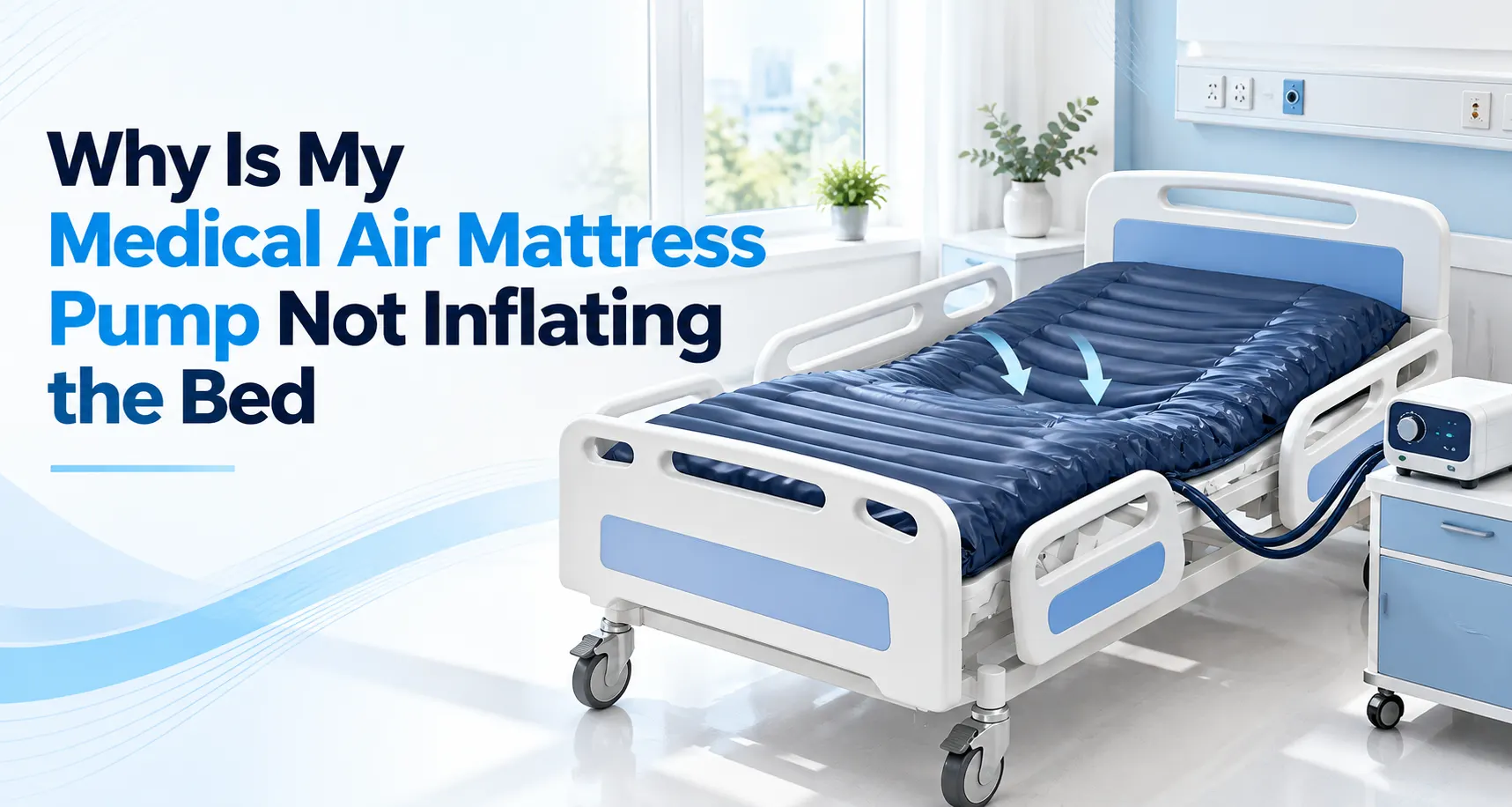
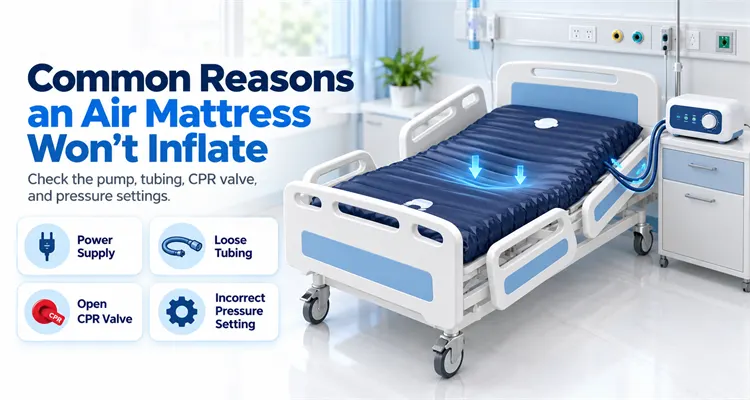
If a medical air mattress pump is running but the mattress does not inflate, the most common reasons include a blockage in the tubing; an incomplete connection; an open CPR valve; a leak in the air system; a clogged intake filter; or inadequate pump performance. Begin with the mattress and hose route and then proceed to fix each issue individually. Leave the interior inspection of the pump to the designated service center.
Before attempting to resolve a problem, ensure that the user has a proper surface to lie on and support to assist with the transfer or movement of the user from one position to another as specified in the care plan. If possible, try to inspect the user’s empty mattress before beginning the startup process for the specific mattress and pump used, since each product will have different inflation times, CPR control options, connector locations, alarm functions, and testing procedures.
Identify the Inflation Pattern Before Changing Anything
The words not inflating can describe several different faults. Observing the pattern narrows the search and prevents unnecessary adjustments.
| What You Observe | Most Likely Area to Check | First Action |
|---|---|---|
| The whole mattress stays flat | Main hose, connector, CPR valve, pump output | Check the complete air path from pump to mattress |
| The mattress inflates very slowly | Kinked tube, partly open CPR valve, dirty filter, small leak | Compare with the model’s initial inflation time |
| One cell or one zone stays flat | Cell hose, manifold connection, damaged cell | Inspect the affected section and its connection |
| The mattress inflates and then softens | Leak, loose connector, CPR seal, mode change | Listen and watch for pressure loss after inflation |
| Alternate cells soften and refill | Normal alternating cycle may be active | Observe a complete cycle before diagnosing a fault |
| Pump runs with a low-pressure alarm | System cannot reach or maintain target pressure | Read the indicator, then follow the checks below in order |
Do not assume every soft cell is defective. In alternating mode, one group of cells may reduce pressure while another group supports the surface. A fault is more likely when the expected groups do not refill, the mattress never reaches its ready state, or a low-pressure indication remains beyond the model’s normal startup period.
Follow the Air Path in Seven Steps
Step 1: Confirm Startup, Mode, and Inflation Time
Confirm the pump is linked with the compatible mattress, turned on and is functioning in the selected operation mode. Many systems include controls for transport, standby, mute, seat-inflate, static or maximum-inflate which alter the function of the pump. A motor noise by itself cannot confirm that air is being delivered to the appropriate outlet.
- Check the pump and mattress model numbers and connector compatibility.
- Confirm that a pause, standby, or transport function is not active.
- Read the pressure, mode, and alarm indicators rather than relying on sound.
- Allow the complete initial inflation period stated for the model.
- If the system has a ready indicator, wait for that state before judging support.
The time required to inflate a large replacement mattress is typically longer than that of a small mattress overlay. Additionally, bed movement (articulation) and additional weight can affect the rate at which the mattress system becomes operational. Therefore, the first step in diagnosing potential problems with the mattress system should be done with the bed in a flat position and without any additional weight, provided that the product manual permits such testing.
Step 2: Follow the Air Tubes from Pump to Mattress
Check each tube using your hands and eyes to verify it is clear of obstructions from the point of connection to the pump to the point where the tube enters the mattress. Be sure to check around the headboard, on the side of the bed frame, under the fixing straps, and around any articulating areas of the bed. Tubes can look like they are attached when in reality they are compressed by the bed platform or sharply bent at the foot end of the bed.
Tube Restrictions to Look For
- A sharp bend immediately behind the pump connector.
- A twist formed while the mattress was unpacked or turned.
- Tubing trapped beneath the mattress, bed deck, side rail, or actuator.
- A fixing strap wrapped around the air hose.
- A split, flattened section, abrasion, or damaged end fitting.
- Insufficient slack when the backrest or bed height changes.
To straight-line the route with no tension on the hose, then either restart or reset the system as instructed in the manual and determine if the mattress is beginning to fill. After inflation, cycle the bed through all of its regular positions to ensure that the restriction will not come back.
Step 3: Reseat Every Hose Connector
A connector may appear to be correctly aligned with the other part; however, it has not yet reached its locked state. Follow the manufacturers’ instructions regarding switching off or pausing the system. Release the connector, check that there is an intact seal and fit. Align the keyed or color-coded parts. Re-connect the connector until the latch is completely engaged.
- Check for cracked plastic, bent fittings, contamination, or a missing seal.
- Make sure multiple ports are connected in the correct channel order.
- Confirm that a blanking cap or transport cap is not blocking an active port.
- Use a gentle pull check only if the connector design permits it.
- Listen for persistent air escape around the joint after restart.
Do not attempt to attach a connector from a different pump or mattress. Although the shape may appear to be the same as the correct connector, this does not mean that the internal channel layouts, seal depths, pressure controls, and flow capacities are compatible.
Step 4: Close and Secure the CPR Valve
When activated, the CPR release is designed to allow the mattress to quickly deflate. If it remains partially closed, open, or incorrectly positioned after being cleaned, transported, or tested; the pump will continue running without creating pressure.
- Locate every CPR control identified for the mattress model.
- Check the label or diagram for the normal operating position.
- Close, insert, twist, or latch the control exactly as instructed.
- Inspect the surrounding seal and closure for visible damage or trapped material.
- Restart the inflation check and confirm that the valve stays engaged.
Consiglio pratico: After you have cleaned or moved the mattress, make sure to include the CPR closure in your pre-use checks. This is because a valve could still remain open despite the other components being in place.
Step 5: Look for a Cell, Hose, or Manifold Leak
If you have verified that the principal connection and CPR valve are working properly, examine the mattress itself. Air will leak from a cell that has been pierced, a split inside tube, a loose cell connection, a broken manifold or a leaking CPR seal just as rapidly as the pump is delivering air.
How the Leak Pattern Helps
- One flat cell points toward that cell or its branch connection.
- One flat alternating group may indicate a channel or manifold problem.
- A mattress that fills and then gradually softens suggests continuing air loss.
- A clear hiss near a joint helps localise the inspection area.
- A pump that runs continuously may be compensating for a leak elsewhere in the system.
Do not remove the cover until the operator’s instructions allow you to. Do not pull on the cell tubing. Use a leak-testing or servicing procedure that is approved by the manufacturer. Adhesives, sealants, heating, sharp instruments and non-approved patches used in homes can damage the material and/or make future repairs more difficult.
Replace a damaged cell or hose only with a compatible replacement and connect it to the proper channel location. If you find that the leak is within a sealed manifold, or if you cannot determine the location of the fault until the system has been disassembled, then label the mattress and send it in for service.
Step 6: Inspect the Pump Intake Filter
Many medical air mattress pumps pull in outside air through an easily accessible filter. Outside air may contain many types of particles such as dust, lint, hair, and bedding fibers. These types of particles can block the intake of air, which will cause the initial inflation of the mattress to take longer than normal, or prevent the system from being able to regain lost pressure due to leaks or positional changes.
- Place the pump in the safe condition stated for filter access.
- Locate the user-serviceable filter and note its orientation.
- Check for visible dust, fibre loading, moisture, deformation, or deterioration.
- Clean or replace it only by the method and interval specified for that model.
- Refit the cover correctly before restarting the pump.
Do not run the pump without its specified filter or substitute denser household foam. An incorrect filter can allow contamination into the pump or restrict airflow further.
Step 7: Decide Whether Pump Output Needs Service Testing
After checking the hose route, connector, CPR valve, cell, and filter, if the mattress does not inflate fully it may indicate that there is not enough pump output, a valve that does not allow air flow, a sensor issue, or an internal control malfunction. Even with a motor running, it could be producing very little usable airflow.
Use only the model’s approved output test, diagnostic mode, test adapter, or service procedure. You may use a known good mattress or pump that is compatible with your model to determine which part of the system is failing, provided the manufacturer or service process allows you to compare the two systems. Do not attempt to open up the unit’s housing, bypass any alarm features, block outlet ports with your hands, or change the settings of any internal valve in order to test the unit.
When reviewing replacement medical air mattress pumps, match the mattress connector, number of air channels, airflow requirement, pressure range, operating modes, alarm logic, power specification, and intended system. Physical connection alone is not enough.
Move the Pump to Technical Service When
- There is little or no airflow after all external restrictions are excluded.
- The pump repeatedly shows a fault with a correctly connected, leak-free mattress.
- The housing, cord, plug, connector, control panel, or pump hooks are damaged.
- The unit produces unusual heat, odour, scraping, or irregular mechanical noise.
- A known-good compatible setup works with another pump but not with this unit.
- The fault returns after a temporary reset or after the system reaches pressure.
Recheck the System After the Cause Is Corrected
Do not stop the test as soon as the first cell rises. Allow the mattress to complete its initial inflation and at least one operating cycle or commissioning period stated for the model. Check the surface from head to foot, confirm that all expected cell groups change correctly, and make sure the low-pressure indication clears.
- Reconnect bedding without covering the pump or restricting the mattress.
- Profile the bed and confirm that hoses remain open in every planned position.
- Verify the intended mode and pressure setting after any reset.
- Record the observed fault, item corrected, replacement part, and final test result.
- If the cause remains uncertain, keep the system out of use until it is checked.
Domande frequenti
Why Is the Pump Running Continuously
While normal in some cases (e.g. after first inflating), continuous running can also indicate that the system is replacing air lost due to a leak, an open CPR valve, a loose connector, or a damaged cell. You should compare the system’s behavior with the normal cycle outlined in the instructions for your model.
Can a Dirty Filter Stop the Mattress from Inflating
If a filter is severely restricted, it will significantly lower the rate of air entering the system and cause the process of inflating to be extremely slow. Only inspect and service the user serviceable filter using the techniques that are provided in the manual for the pump.
Why Is Only Half of the Mattress Inflated
Cells are divided into groups by alternating systems, with one group being softer during some parts of the cycle. When the same group does not refill, examine its associated channel, connector, manifold, and cells.
Should the CPR Valve Be Open During Normal Use
No. The CPR control normally remains closed and secured during inflation and routine operation. Its exact closure method depends on the mattress design.
Can Any Pump Be Used with the Mattress
No. The pump must match the mattress architecture, connectors, channels, pressure and airflow requirements, modes, alarms, and power specification. Use the approved combination for the exact system.
Conclusione
If your medical air mattress pump is working, however the mattress remains empty, go through the air line in order: verify that the pump has turned on and is set to the correct mode, make sure all the lines are straight, re-attach all connectors, shut off the CPR valve, look at each cell and each hose inside the mattress, check the filter, and determine if the pump output needs to be tested for service.
The way in which your symptoms appear can indicate what area to check. If the entire mattress is completely flat then it will likely indicate the main air line. However if there is only a portion of the mattress that is flat then it would probably be a cell or channel. If the mattress takes longer than normal to inflate then there may be a restriction or small leak in the system. Lastly, if the pressure does not remain constant then it may mean that the system continues to lose air or is producing insufficient air flow. Only fix one problem at a time and do a complete check of the system’s function prior to using the system again.