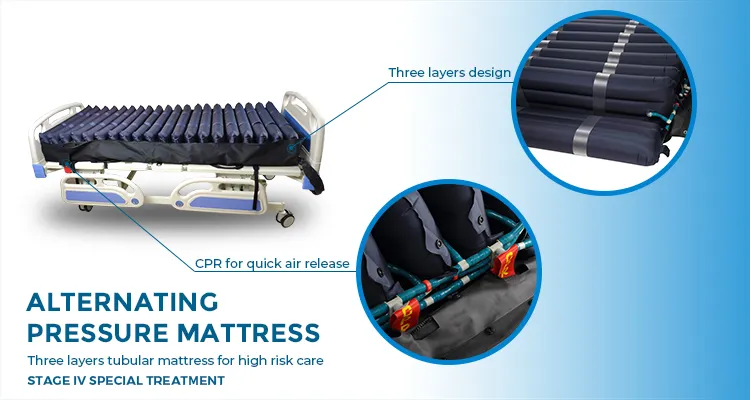
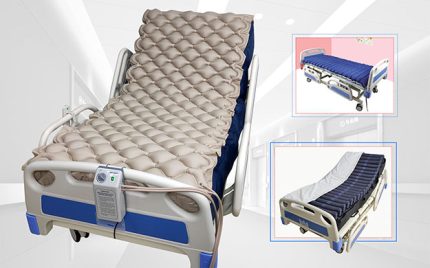








When an alternating pressure mattress loses power, it stops active cycling; however, the surface may still be functional for some time. How long this can continue depends on several factors: the construction of the mattress, the use of non-return valves, how the hoses are connected to the pump, whether there is a transport cap/clamp available, if there is a foam base beneath the air cells, whether there is a battery back-up system, what weight is being placed on the mattress, and how long the power interruption will last. A safe course of action would include having a specific plan for your particular model that addresses observation of the patient, handling of the hoses during transportation, resetting the mattress, etc.
While power loss and patient transportation have some similarities, they are distinct. When a power loss occurs, the focus is on providing a suitable support surface and observing for changes. In addition to preparing for the move (the mattress, pump, cables, and hoses), static mode, transport mode, battery operation, and CPR deflation each serve different purposes and cannot be used interchangeably.
Know the System Before Power Is Interrupted
A useful outage plan begins with the exact mattress and pump instructions. Product families can respond differently even when their control panels look similar.
| System Detail | Éléments à vérifier | Why It Changes the Response |
|---|---|---|
| Air retention | How pressure changes after the pump stops | Determines how quickly support may reduce |
| Hose connector | Whether it contains non-return valves | Some connectors retain air better when left attached |
| Transport device | Cap, plug, clamp, dial position, or none | Defines the approved way to limit air loss during movement |
| Foam base | Presence, thickness, and intended backup role | May provide underlying support as air pressure falls |
| Battery or backup power | Approved type, runtime, charge indication, and load | May allow continued pumping for a defined period |
| Alarm and memory | Power-failure alert and restart behaviour | Shows whether settings must be re-entered |
| Transport limit | Permitted duration and conditions | Prevents a temporary transport state becoming routine use |
Keep the model instructions, pump identity, normal mode, usual setting, outage contacts, and alternative support plan available near the equipment record. A short controlled test can confirm alarm and restart behaviour when it is authorised and the mattress is not supporting a user.
Prepare for a Planned Power Interruption
Planned electrical work, room changes, bed maintenance, or scheduled transportation will give you time to plan. You should find out how much time the electricity will be off and then see how long the manufacturer says the item can travel or retain air for during that time.
Preparation Checklist
- Identify the exact pump and mattress combination and read its power-loss instructions.
- Confirm the current operating mode and pressure or comfort setting.
- Check whether the pump includes a charged approved battery or approved external backup supply.
- Locate the model-specific transport cap, plug, clamp, or connector position if one is provided.
- Confirm that the CPR control is closed and will remain accessible.
- Inspect hoses, cells, cover, power cable, and connectors before the interruption.
- Arrange an alternative support surface or transfer plan if the interruption may exceed the approved condition.
- Decide who will observe the surface, reconnect power, and verify restart.
Do not assume that a general-purpose uninterruptible power supply is suitable. Electrical rating, output waveform, grounding, alarm behaviour, runtime, inspection, and local equipment policy all matter. Use only a backup source approved for the device and setting.
Respond to an Unexpected Power Outage
First determine if the electrical problem is affecting only the outlet, the entire room, or the rest of the building. Make sure the pump’s power cord is plugged in and check for damage on the cord. If there are any other indications of a loss of electricity such as visual or audible indicators, do not switch the control repeatedly to verify them.
- Check the user, mattress shape, bed position, and immediate support condition.
- Note the time active pumping stopped or was discovered to have stopped.
- Keep the CPR release closed and avoid disconnecting hoses unless the model’s outage procedure requires it.
- Follow the approved transport or air-retention step for that exact connector design.
- Reduce avoidable movement, sharp bed profiling, and anything that compresses the hose or mattress.
- Begin the alternative support or transfer plan if support is declining or power will not return within the permitted condition.
- Continue observation until active operation is restored and checked, or the user is supported elsewhere.
Conseil pratique : Record the outage start time on paper or the care record as soon as it is known. This is more reliable than trying to estimate duration after the mattress has already softened.
Observe the Mattress Surface While the Pump Is Off
A non-audible pump is no longer adjusting pressure or performing an alternating cycle. The mattress can continue to hold its air, gradually release its air, or lose air very fast through a leak in the connector or cell. As such, the focus of observations should be on the overall state of the support surface, as opposed to just whether the pump is making noise.
Changes to Watch
- A visible reduction in mattress height or a change from the normal profile.
- The user settling deeper or moving closer to the bed base.
- One cell group losing air faster than the rest of the mattress.
- A hose, connector, CPR control, or cover position changing as the bed moves.
- Reduced edge stability during repositioning or preparation for transfer.
- A change in comfort, posture, alignment, or ability to move safely.
When possible use the model’s specified base support or bottom-out check. Do not push through the cover forcefully, nor rely on a single hand check if you are required to use another method. The frequency of repositioning, timing of transfers, and use of alternate surfaces must be based on the individual’s current care plan and observed status.
Handle Air Hoses According to the Transport Design
Hose handling determines how much air escapes from many systems. On some mattresses, leaving the connector attached to an unpowered pump helps retain air. Other systems instruct the operator to disconnect and immediately fit a transport cap, join hose ends, close a transport dial, or apply a dedicated clamp.
- Use only the transport component supplied or specified for that mattress.
- Do not improvise by knotting tubing, folding it tightly, or clamping it with general tools.
- Never open the CPR control to prepare for routine transport.
- Keep capped or disconnected hose ends clean and protected.
- Avoid placing the connector beneath the mattress or where it can be struck by the bed frame.
- After transport, restore the normal hose configuration before restarting the pump.
A transport cap limits air loss only when the surrounding cells, hoses, seals, and CPR closure are intact. It does not turn every mattress into a long-duration non-powered surface.
Prepare the Mattress for Short-Distance Patient Transport
A transport cap will prevent air from leaking out of the mattress, but only if all of the components that make up the mattress (i.e., cells, hoses, seals, CPR closure) are functioning correctly. A transport cap is not able to convert each mattress into a non-powered surface with extended durability.
When the User Travels on the Bed
- Allow the mattress to reach its normal operating state before disconnecting power when time permits.
- Apply the model-specific transport setting, cap, connector, or approved battery procedure.
- Secure the pump in its approved position or place it in the designated transport location.
- Coil and secure the power cable so it cannot reach castors, floor, rails, or door frames.
- Route hoses with enough slack for bed movement but without hanging loops or pinch points.
- Confirm that the CPR control remains accessible and closed.
- Observe mattress height and user position during pauses and immediately on arrival.
Do not use the power cable as a hanging point for the pump, and avoid allowing it to move freely while being carried via the hose connection. In cases where the pump will not stay firmly in place during travel, you must only utilize the approved storage/travel methods outlined within the system’s documentation.
When the User Transfers to a Stretcher or Chair
The transfer will depend upon what type of handling equipment has been selected and the assistance plan. You need to determine if the air mattress stays in place on the bed; travels with the user as a viable transfer surface; or if a different support surface replaces the air mattress at the final destination. A standard alternating mattress can not function as an air-assisted transfer mattress unless it was specifically designed to do so.
When the user gets out of bed, ensure that the identification of the mattress and pump setup is maintained. Additionally, prevent any loose cables/hoses from becoming a safety hazard (trip) and do not leave the system inflated fully, in transport mode, or disconnected from power supply unless there is a clear label indicating its status.
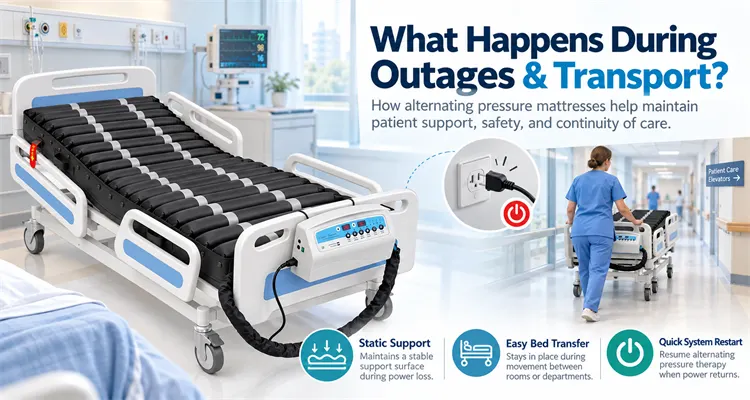
Restart the System as a Recommissioning Check
When you are ready to turn on the power, or when the bed has reached where it is supposed to be, then you need to plug it back in. This will be your initial start-up process. As such, consider restarting as a quick check-out to make sure that nothing was disturbed during travel; i.e., whether the settings on the unit, the positioning of the hoses, the closing of the CPR valve, and the pressure of the mattress has changed.
- Place the bed in the position specified for restart and apply its brakes.
- Remove the transport cap or clamp and restore every hose to its normal connection.
- Confirm that connectors are locked, hoses are open, and the CPR control is closed.
- Inspect the power cable and connect the pump to the approved supply.
- Watch the startup self-test, display, and alarm indicators.
- Re-enter or verify the intended mode and pressure setting; do not assume memory retained them.
- Allow the mattress to reach its ready state and observe the expected cell sequence.
- Check support, user position, bed movement, hose routing, and alarm status before routine use resumes.
While a soft mattress is inflating again, the low pressure alarm can stay on. This will depend upon the specific model’s startup sequence. When the alarm continues to ring after the soft mattress has been re-inflated, check the following areas prior to putting the system back into service: Transport Device, Hose Connection, CPR Valve, Cells, Filter and Pump Output.
Record the Event and Restore Readiness
A quick record will assist you in explaining future changes to your mattress pressure, settings, alarms, or equipment status. You should make note of the time when the interruption began and ended, which mattress and pump were being used, if there was transportation involved, what the hoses or caps look like, if back up power was utilized, any observations made about the surface, the reaction of the user, the restart settings, the alarms, and the final test results.
Lors de l'examen systèmes de matelas à pression alternée, look for clear power-failure instructions, transport components, alarm behaviour, setting memory, compatible battery information where available, and a restart checklist. These details influence daily usability as much as the normal alternating cycle.
After-Event Equipment Checks
- Recharge an approved battery and record any reduced runtime or warning.
- Return caps, clamps, and carrying accessories to their assigned location.
- Inspect connectors and cables for damage caused during movement.
- Clean any component that contacted the floor, lift, corridor surface, or transport equipment.
- Report a persistent alarm, rapid air loss, failed restart, or changed pump sound.
- Update the outage plan if the actual event exposed missing instructions or equipment.
Questions fréquemment posées
How Long Will an Alternating Pressure Mattress Stay Inflated Without Power
The amount of time the air is held in the mattress will vary depending upon the type of mattress being used, the type of valve used, where the connector is located, what type of transport device is used, whether there are leaks in the cells, how much weight is applied to the mattress, and what position the bed is placed in. Use the specified times and conditions that apply to your particular model.
Should the Air Hoses Be Disconnected During a Power Outage
Only if the product instructions say to disconnect them and explain how to retain air afterward. Some systems hold air better while connected; others use a transport cap, plug, dial, or clamp.
Is Static Mode a Backup During a Power Outage
No. Static mode will still require a running pump for the maintenance of a controlled pressure. When the system loses power, there will be no active pressure control or cycling.
Can the CPR Valve Be Used as a Transport Control
The purpose of the CPR control is to quickly deflate the mattress. During routine transport, the method used with the mattress (i.e. leaving the connector plugged in or using the designated transport accessory) should be followed.
What Should Be Checked After Power Returns
Check hoses, transport components, CPR closure, power cable, startup indicators, mode, pressure setting, inflation, cell sequence, user support, bed movement, and unresolved alarms.
Conclusion
To manage an alternating pressure mattress when you experience power loss, you need to be prepared before the power goes out. This preparation includes understanding how the specific mattress retains air, what kind of connector or transport device it uses, if there is a backup power source that has been approved for use with your particular model, and when you should initiate an alternative transfer strategy.
During an outage, you should focus on the surface and user instead of only focusing on the silent pump. When transporting, be sure to secure the pump, cable, and hoses. Do not use the CPR release as a transport control. After power has returned, restore the normal air path; verify settings; allow reinflation; check the operating cycle; and document the final status.