
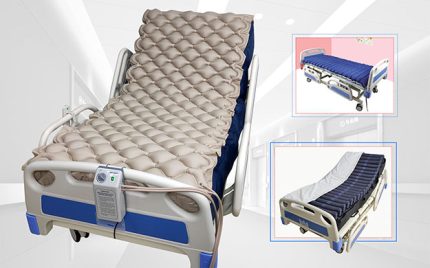








The mode of a medical air mattress describes how air travels through the mattress to support the user. With the alternating mode, air cycles between the cells to provide support. In contrast, the static mode maintains a specific level of support. Neither mode is universally better. For example, in a situation where a patient becomes agitated by the cycle of cell inflation and deflation in an alternating mode air mattress, switching to static mode would be more appropriate. The chosen mode for a mattress is also dependent on the pump design.
This guide explains the differences between modes to avoid mistaking a temporary stability setting of a static mode mattress for a continuous support setting of an alternating mode mattress. This advice is also helpful to purchasing directors because they can choose between similar types of pumps, instead of judging the number of controls on a pump panel.
1. How Alternating Mode Works
In alternating mode, a pump sends air to separate mattress cells. As one cell group inflates, another group deflates. With a two-channel system, the A/B groups alternate in time. Some systems use three groups, but others may have a different pattern.
In this mode, the cycle of inflation and deflation will never fully relax the system. The support surface is maintained.
What A Buyer Should Confirm
- The cell sequence used by the mattress, such as A/B or A/B/C.
- The available cycle times and whether they are fixed or adjustable.
- How pressure is selected by weight range, comfort level, or automatic sensing.
- Whether the head cells remain static and how the lower cell groups alternate.
- How the panel indicates that alternating operation is active.
When comparing alternating pressure mattress systems, confirm the pump and mattress as one system. A pump with the wrong outlet arrangement, airflow, or cycle logic may not operate the mattress correctly even if the hose connector appears to fit.
2. How Static Mode Works
Static mode stops the alternating cycle and evens out the pressure to maintain a more stable, non-alternating surface. Some systems may hold all cells at equal pressure, some systems may lower all cell pressures to a constant low support pressure, and some systems may have an auto firm function to increase mattress firmness. The function may not work the same as expected.
A stable surface may be a benefit to the care plan and provide stability for bedside tasks and comfort during transfers. It may be appropriate for use when the movement of an alternating surface is poorly tolerated. The product instructions and the individual careplan should determine the function.
Static Mode Is Not The Same As Turning The Pump Off
For the system of the power mattress, static mode means that the system continues controlling the pressure of the mattress. When the pump is turned off, the pressure control is also turned off and air will start to escape. Static mode, power-failure condition, transport setting, and CPR release are all distinct modes of operation.
3. Static Mode And Alternating Mode Compared
| Comparison Point | Alternating Mode | Static Mode |
|---|---|---|
| Airflow pattern | Air moves between defined cell groups | Cells remain at a more consistent support state |
| Surface behavior | Support changes through a timed cycle | Surface remains non-alternating |
| Typical role | Ongoing dynamic operation | Selected procedures, positioning, or tolerance needs |
| Pump status | Pump cycles channels according to its program | Pump continues regulating pressure without the alternating sequence |
| Time control | Fixed or selectable cycle duration | Manual return or timed automatic return, depending on model |
| Important indicator | Active mode and cycle status | Clear static or auto-firm indicator |
| Main operating risk | Incorrect pressure or incompatible pump settings | Forgetting to return to the intended ongoing mode |
| Procurement focus | Cycle options, pressure control, alarms | Mode distinction, timer, reminder, and return behavior |
4. When Alternating Mode Is Usually Selected
The default mode for most dynamic mattress systems is alternating. This mode is most appropriate when the support strategy involves changes in pressure over time and the user has been shown to tolerate the movement of the surface.
- Confirm the mattress has reached its operating pressure before use.
- Select the pressure or weight setting specified for the system.
- Check that the cycle indicator changes as expected.
- Inspect hoses for kinks and confirm connectors are secure.
- Recheck support after changes in body position or bed profiling.
Alternating operation remains part of a wider routine that includes repositioning decisions, skin observation, linen management, nutrition, moisture management, and documentation.
5. When Static Mode May Be Useful
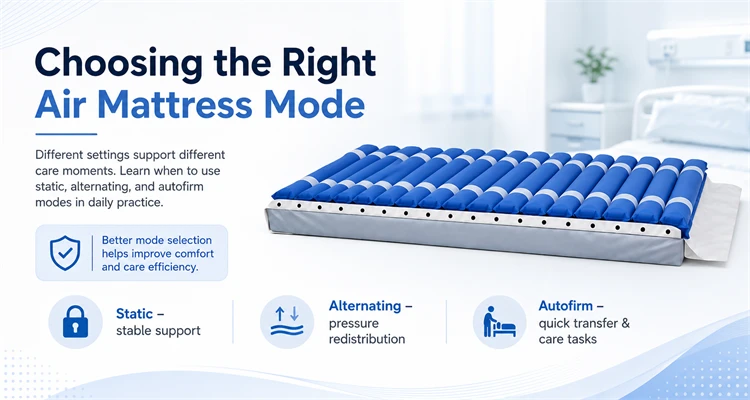
Most systems have a static mode. It may be a preferred mode while performing a dressing change, when using a bedpan, or even during a reposition or a series of tasks preceding a transfer. It is appropiate for some systems to use a soft pressure mode, while others use an auto firm control where the surface automatically stiffens.
A static mode may also be used when the user cannot tolerate the moving surfaces of alternating cells. Such a decision should take the user’s mobility, the instructions of the system, skin, level of discomfort and support, and the frequency of checks, into account.
6. A Clear Process For Switching Modes
- Identify why a stable surface is needed and check the relevant handling plan.
- Confirm the current pressure setting and active mode before making a change.
- Select static or auto-firm and verify the indicator on the control panel.
- Wait until the surface reaches the required support state before starting the task.
- Complete the procedure while monitoring body position and mattress support.
- Return the system to the planned ongoing mode and confirm the indicator.
- Record the change when the facility’s procedure requires it.
There is no need to impose a universal limit on the use of static mode. Different pumps have different behaviors. Some pumps automatically return from static mode after a fixed time period while others remain in static mode until a user alters the setting. The instructions must be clear to all users to facilitate operation.
7. Pump Functions That Matter During Procurement
The most useful medical air mattress pumps that have a static mode make the operating status clear and reduce the risk of an unnoticed mode error. Therefore, when evaluating a pump, purchasers need to review the entire user interface, not only the available pressure ranges.
| Pump Function | Why It Matters | What To Verify In A Sample |
|---|---|---|
| Mode indicator | Shows whether static or alternating is active | Visibility from normal working distance |
| Automatic return | Limits unintended extended use of a temporary mode | Return time, warning, and previous-setting recovery |
| Pressure adjustment | Matches support to system design and user needs | Range, step size, and control clarity |
| Cycle selection | Allows different alternating intervals where supported | Actual cycle timing under load |
| Low-pressure alarm | Identifies leaks, disconnection, or incomplete inflation | Audio, visual signal, mute behavior, and reset |
| Power-failure indication | Helps staff identify loss of active operation | Alarm duration and restart behavior |
| Panel lock | Reduces accidental setting changes | Lock method and emergency accessibility |
| Setting memory | Supports predictable restart after interruption | Which mode and pressure values are restored |
8. How To Test Mode Performance Before A Bulk Order
A sample test should involve running the system as designed with the mattress, pump, hoses, cover, and the expected load. Conducting a short power-on demo is not sufficient to understand mode performance.
- Time the initial inflation and confirm the ready indication.
- Observe at least one complete alternating cycle and identify each cell group.
- Switch to static mode and check surface stability under load.
- Confirm whether static mode returns automatically or requires manual selection.
- Create a controlled hose disconnection to check the low-pressure alarm.
- Interrupt power briefly and verify the alarm and restart sequence.
- Ask unfamiliar staff to identify the active mode and complete a mode change.
- Repeat the test after cleaning and reconnection to expose connector or setup problems.
9. Common Mode Selection Mistakes
- Assuming every static mode produces the same cell pressure.
- Using auto-firm and constant low-pressure mode as interchangeable terms.
- Leaving a temporary mode active after a care procedure.
- Treating pump-off or transport conditions as static operation.
- Selecting a pump by connector shape without verifying airflow and cell sequence.
- Relying on panel labels that are difficult to see or understand.
- Skipping alarm and power-recovery tests during sample approval.
Conclusion
Alternating mode puts cells in a timed sequence to change cells. In the case of static mode, the surface is non-changing and remains in a constant state. In the case of alternating mode, the majority of systems in this mode will operate in a constantly changing and dynamic state. Static mode, auto-firm mode, and constant low pressure mode serve different functions and can operate different on different units.
A good purchase displays an understanding of definitions of modes, components of pressure control, cycle timing, automatic return, alarms, panel lock, restart behavior and mattress compatibility. Important considerations as well are controls that are clear to the operator and a switching mechanism that has been tested.
FAQ
The Main Difference Between Static And Alternating Mode
In alternating modes, groups of cells alternate support in a timed cycle, while in static mode, the surface is held in a non-alternating state.
Whether Static Mode Can Remain On Continuously
Whether a static mode can remain on continuously depends on the system and the intended use. Some static modes are designed to be used for a short time and will return automatically. Other modes are designed to be used for a long time with low pressure. Check the supplied information.
Whether Static Mode Means The Pump Is Off
No. In static mode, the pump is on and the pressure is controlled. Pump-off, transport, and CPR release are different conditions.
How To Confirm Which Mode Is Active
The mode indicator on the control panel can be used to confirm the mode active and the expected cell behavior. Just listening for the pump is not sufficient to confirm mode.
The Most Important Pump Features To Compare
The most important features include clear and easy to understand mode indicators, pressure control, cycle control, automatic return behavior, alarms for low pressure and loss of power, panel lock, restart behavior, and mattress compatibility.